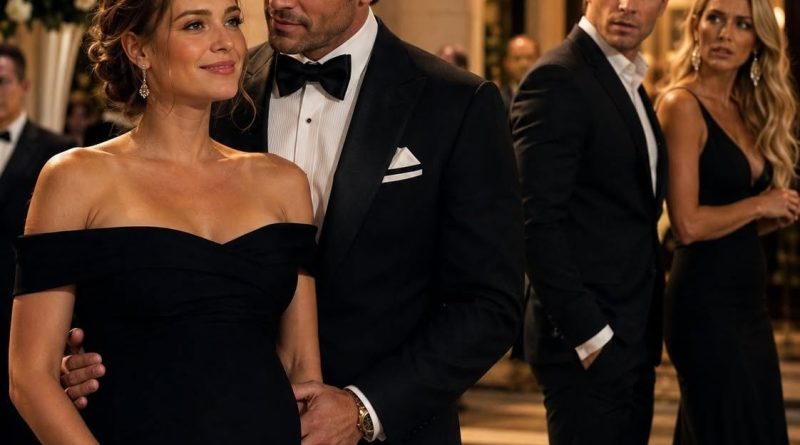
He Left His Wife for a Model—Now He’s Jealous Seeing Her Pregnant and Happy With a Billionaire
He Left His Wife for a Model—Now He’s Jealous Seeing Her Pregnant and Happy With a Billionaire
Olivia walked into the gala six months pregnant and watched her ex-husband forget how to breathe.
He had left her for a model because he wanted a woman who made him look richer.
By morning, every camera in New York had seen what he had thrown away.
The champagne glass slipped from Liam Hayes’s hand before anyone in the Plaza ballroom understood why.
For one sharp second, the room went perfectly still. The glass hit the marble floor and burst into a spray of crystal, champagne, and reflected chandelier light. A nearby senator’s wife gasped. A waiter froze with a silver tray of oysters balanced in one hand. The string quartet kept playing because professionals were trained to survive scandal with a straight bow.
Across the ballroom, Olivia Carter stood beneath the golden archway in a white silk dress that moved softly over the curve of her pregnancy.
One hand rested on her belly.
The other held a slim leather folder against her side.
She had not come there to ruin him.
That was the part no one would believe later.
She had come because inside that folder were the last signed documents connecting her to Liam Hayes, the man who had once promised to build a life with her when they had nothing but a two-room apartment in Queens, student debt, and an old coffee maker that leaked onto the counter every morning.
Now he stood in the center of the Plaza ballroom beside Khloe Monroe, a twenty-five-year-old model with diamond earrings, a champagne gown, and the glossy confidence of a woman who had never had to pack her marriage into cardboard boxes.
Liam’s hand had been on Khloe’s waist all night.
Possessive.
Public.
Careless.
That had not surprised Olivia. She had seen the photographs. Everyone had. The tabloids loved symmetry: billionaire tech founder leaves loyal wife for glamorous model, rebrands life as courage, calls it freedom.
It was her stomach.
The small, undeniable swell beneath white silk.
The proof that when Liam pushed Olivia out of his penthouse six months ago with a severance-style divorce settlement and a speech about outgrowing each other, he had also abandoned the child neither of them yet knew she carried.
Or rather, the children.
Olivia felt the twins kick once, a soft pressure low in her abdomen, as if they had heard the silence gathering around their mother.
Cameras shifted.
First one.
Then five.
Then all of them.
The photographers who had been pointed toward Liam and Khloe turned like metal flowers toward sunlight. Flashes exploded across Olivia’s face, lighting the calm expression she had practiced for months but never expected to need in a room like this.
Khloe’s smile tightened.
Liam’s mouth opened.
No sound came out.
Olivia looked at him across the room.
Six years of marriage lived inside that single look.
The first apartment with the radiator that screamed all night. The early mornings when she ironed his shirts while he rehearsed investor pitches in the bathroom mirror. The campaigns she built for Hayes Vision before anyone knew his name. The speech she rewrote the night his first product nearly failed because he had been too proud to admit he did not know how to speak to ordinary customers.
His empire had learned to sound human through her voice.
Now that voice was silent.
Someone whispered, “Is that his ex-wife?”
Someone else answered, “Pregnant?”
The word moved through the room with brutal speed.
Pregnant.
Pregnant.
Pregnant.
Liam finally stepped forward.
“Olivia.”
He said her name like a man reaching for something falling from a high place.
She did not move.
Khloe’s hand tightened around his arm.
“Liam,” she murmured, low enough that only the people nearest them heard, but not low enough to hide the panic. “Do something.”
Do something.
Olivia almost smiled.
That had always been Khloe’s understanding of men like Liam. They did things. They bought rooms, paid people, rewrote narratives, buried inconvenient facts beneath newer, shinier ones.
But some truths arrive in public already dressed for court.
Olivia lowered her eyes to the broken glass near Liam’s shoes, then lifted them back to his face.
She gave him one small nod.
Not forgiveness.
Not greeting.
Acknowledgment.
Then she turned and walked toward the side exit.
The ballroom held its breath as she passed. Women in diamonds turned their heads. Men who once dismissed her as Liam’s quiet wife suddenly watched as though she had become the most expensive thing in the room. A reporter tried to speak her name, but Olivia kept walking, every step measured, her palm steady on her belly.
At the door, an older woman in a black catering uniform leaned close and whispered, “Hold your head high, honey.”
Olivia did.
Outside, November air struck her face like cold water.
The Plaza lights glowed behind her. Fifth Avenue shone wet from an earlier rain, the pavement reflecting taxis, headlights, and the sharp blue-white pulse of paparazzi already beginning to spill out behind her.
A black town car waited at the curb.
The driver stepped out and opened the rear door.
“Ms. Carter?”
She paused.
“I didn’t call a car.”
“No, ma’am.” The driver’s voice was gentle. “Mr. Blackwell did.”
Olivia looked past him.
Inside the car, Ethan Blackwell sat in the shadows, wearing a charcoal overcoat and an expression so still it almost seemed formal. Billionaire philanthropist. Founder of the Blackwell Foundation. A man she had met years earlier at a charity gala when she was still Liam’s wife, still the woman behind the speeches, still invisible in the ways powerful men preferred their wives to be.
Ethan opened the opposite door and stepped onto the curb.
He did not rush toward her. He did not touch her. He simply looked at her with a steadiness that did not demand performance.
“I saw the cameras turn,” he said. “I thought you might want a quieter exit.”
For the first time all evening, Olivia’s control trembled.
Just slightly.
“You shouldn’t get involved.”
“I’m not involved.” Ethan glanced toward the ballroom doors, where the first photographers had appeared. “I’m offering transportation.”
A flash went off.
Then another.
Liam’s voice came from behind her.
“Olivia, wait.”
She closed her eyes.
The twins moved again.
Ethan did not step in front of her. That mattered. He gave her room to choose whether she would turn.
She turned.
Liam stood on the sidewalk in his tuxedo, his bow tie slightly crooked, his face pale beneath the Plaza’s gold light. Khloe remained behind him near the doorway, arms folded across her chest, her beautiful face sharpened by humiliation.
“Is it mine?” Liam asked.
The question was so ugly in its smallness that even one of the photographers lowered his camera.
Olivia felt something in her chest go quiet.
Not broken.
Finished.
She looked at him for a long moment.
Then she said, clearly enough for the cameras to catch every word, “You should have asked that before you threw me out.”
Liam flinched.
Khloe’s mouth parted.
Olivia turned back to Ethan.
“I’ll take the ride,” she said.
He nodded once and helped her into the car without touching more than the edge of the door.
As the car pulled away, Olivia looked through the rain-streaked window. Liam stood on the curb, surrounded by flashes, no longer the king of the room, no longer the man controlling the narrative.
Just a man in a tuxedo watching the woman he discarded leave with the one thing his money could not buy.
Dignity.
By morning, New York had sharpened the story into a weapon.
CEO’s Ex-Wife Arrives Pregnant at Plaza Gala While He Flaunts Model Girlfriend.
Hayes Vision Launch Overshadowed by Explosive Personal Scandal.
Billionaire’s Pregnant Ex Breaks Internet With Silent Entrance.
Olivia read none of the articles at first.
She woke at six in her small Brooklyn apartment with a dull ache in her lower back and the taste of metal in her mouth. The radiator hissed beside the window. A delivery truck rumbled below. Her phone pulsed on the nightstand like a trapped insect.
Three hundred missed calls.
Texts from former colleagues.
Messages from journalists.
Voice notes from women she had not spoken to since the divorce but who suddenly remembered loving her.
One text from Liam.
Please call me.
Then another.
I didn’t know.
Then another.
Olivia, please. We need to talk privately.
The apartment smelled faintly of coffee grounds and lavender detergent. It was small, almost painfully so after the penthouse Liam had kept, but it was hers. She had chosen the blue curtains from a discount store. She had assembled the bookshelf herself. The nursery corner was still unfinished, just two secondhand bassinets against the wall, a box of folded onesies, and a mobile of paper clouds she had made with trembling hands during a night she could not sleep.
She went to the kitchen, filled the kettle, and stood barefoot on the cold floor while the water heated.
Her body felt heavy now. Six months pregnant with twins had turned ordinary movements into negotiations. The simple act of bending to pick up a spoon required thought. Sleep came in fragments. Her ankles swelled by afternoon. The babies kicked hardest when she was anxious, and they had been kicking all night.
“I know,” she whispered, resting both hands on her belly. “I know it was a lot.”
The kettle clicked off.
Her phone rang again.
This time it was not Liam.
It was Mara Ellis.
Her old boss from the PR firm where Olivia had once been considered the best crisis strategist in Manhattan before Liam’s divorce turned her into the crisis.
Olivia answered.
“Good morning, Mara.”
A pause.
“You sound calm.”
“I’m making tea.”
“Olivia.”
There it was.
That tone. Half sympathy, half opportunity.
“I can’t talk long,” Olivia said.
“I saw what happened last night.”
“So did everyone.”
“Listen to me carefully. Hayes Vision is bleeding publicly. Liam’s board is furious. There are already questions about mismanagement, brand instability, leadership judgment. If you have anything — documents, communications, evidence of misconduct — now is the time to use it.”
Olivia looked toward the leather folder on her table.
Inside were signed campaign documents, internal messaging drafts, compensation agreements, and early brand architecture notes proving that Hayes Vision’s first market identity had been created by her before the divorce. Liam had promised to compensate her separately when the company stabilized.
He never had.
After the divorce, his attorney had sent a letter describing her contributions as informal spousal support.
Informal.
That word had followed her for months like a stain.
“I’m not trying to destroy him,” Olivia said.
Mara exhaled. “I know. That’s why he survived you this long.”
The sentence landed with uncomfortable precision.
Olivia looked out the window at the gray morning. A woman across the street shook rainwater from an umbrella. A school bus stopped at the corner, its red lights flashing in the mist.
“I need to think.”
“No,” Mara said, unexpectedly sharp. “You need a lawyer. A real one. Not some family mediator who thinks fairness is a mood. You built half that man’s public identity and walked away with nothing because you were too devastated to fight.”
Olivia’s throat tightened.
“I was pregnant.”
“You were abandoned.”
The word hit harder.
Abandoned.
Not divorced.
Not outgrown.
Not replaced.
Abandoned.
For months, Olivia had softened the truth because the full shape of it felt too humiliating to hold. Liam had not simply left. He had removed her from their home while she was newly pregnant and emotionally stunned, then introduced a model to the world as the woman who finally understood his ambition.
He had not known about the twins.
But he had known about Olivia.
That should have been enough.
“I have someone I want you to call,” Mara said. “Nora Whitcomb. She handles executive compensation disputes and marital asset concealment. She’s expensive. She’s also terrifying.”
“I can’t afford terrifying.”
“You can afford one consultation. After that, I suspect she’ll work on contingency if she sees the file.”
Olivia touched the leather folder.
“Mara.”
“Yes?”
“Why are you helping me now?”
The silence that followed was not empty.
When Mara spoke again, her voice was lower.
“Because I watched you disappear in that marriage. I should have said something sooner. I didn’t because Liam brought prestige to the firm, and I let convenience make me cowardly.” A breath. “I’m trying not to be cowardly today.”
Olivia closed her eyes.
For months, everyone had wanted a piece of her pain.
This was the first apology that did not ask anything in return.
“Send me the number,” she said.
By ten, Olivia was sitting across from Nora Whitcomb in a Midtown office that looked too elegant to be merciful.
Nora was in her late fifties, with silver hair cut blunt at her jaw and black reading glasses hanging from a thin gold chain. She wore a charcoal suit, no jewelry except a wedding band, and had the unnerving stillness of a woman who never wasted motion.
She read the folder in silence.
Olivia sat opposite her with a cup of untouched water and tried not to wince whenever one of the twins shifted sharply beneath her ribs.
Nora turned a page.
Then another.
Then another.
Finally, she removed her glasses.
“Mrs. Carter—”
“Ms. Carter.”
A faint smile touched Nora’s mouth.
“Ms. Carter. How long did you work on Hayes Vision’s brand architecture before the divorce?”
“Three years.”
“Paid?”
“No.”
“Written promise of future compensation?”
“Emails. Some texts. A voice memo from a board prep session.”
“Did he list your intellectual contributions during asset negotiations?”
“No. His attorney said they were marital support.”
Nora’s expression did not change, but something in the room cooled.
“And you signed the settlement under emotional distress?”
“I signed because he told me if I fought him, the press would paint me as a bitter wife trying to sabotage a self-made founder.”
“Was he already publicly involved with Ms. Monroe?”
“Not publicly.”
“But privately?”
Olivia looked down.
“Yes.”
Nora tapped the folder once with one finger.
“Do you want revenge?”
The question startled her.
“No.”
“Good. Revenge makes clients sloppy.”
Olivia swallowed.
“What do I want, then?”
Nora leaned back.
“What you are owed. Compensation for documented labor. Correction of false public narratives. Protection for your children. Discovery into whether marital assets were undervalued or concealed. And, if the board used your work while excluding you from compensation, leverage.”
Olivia stared at her.
It sounded so clean when Nora said it.
Not rage.
Not heartbreak.
Procedure.
Law.
Accounting.
Truth with teeth.
“I don’t want my babies growing up in scandal.”
“Then we move carefully,” Nora said. “No interviews. No public accusations. No emotional posts. We file first where we have standing. Quietly. Then we let his side decide whether they want this to become loud.”
Olivia thought of Liam on the curb asking if the child was his.
Something hardened in her.
“There are two babies,” she said.
For the first time, Nora’s face softened.
“Twins?”
“Yes.”
“Does he know?”
“No.”
Nora nodded slowly.
“Then he will learn through counsel.”
It should have felt cold.
Instead, it felt safe.
Olivia left Nora’s office at noon into a city already feasting on her life.
Her phone remained muted. Outside the building, a tabloid photographer called her name. She kept walking. A younger woman in a gray coat held open the door to a coffee shop and whispered, “You were beautiful last night.”
Olivia almost cried.
Not because of the compliment.
Because for months she had been called many things online — abandoned, replaced, sad, desperate, tragic — but beautiful sounded like the person beneath the damage had been seen for half a second.
Inside the coffee shop, she ordered chamomile tea and sat near the back.
A black sedan pulled to the curb outside.
Ethan Blackwell stepped out.
This time, he entered.
He approached without entitlement, pausing a few feet from her table.
“May I?”
She nodded.
He sat across from her.
“You made sure I got home safely,” she said.
“I asked my driver to. You didn’t need an audience last night.”
“Apparently I had one anyway.”
His expression turned wry. “New York is an audience with traffic.”
Despite herself, she laughed.
It surprised them both.
The laugh was small, rusty, but real.
Ethan’s gaze dropped briefly to her tea, then to her face.
“How are you feeling?”
“Physically or publicly?”
“Both.”
“Physically, like two tiny tenants are renovating my ribs. Publicly, like someone set my private life on fire and sold tickets.”
“That sounds exhausting.”
“It is.”
He did not say I’m sorry in the empty way rich men say it when they need a scene to conclude. He simply sat with the truth for a moment.
“I didn’t know you were pregnant,” he said.
“No one did.”
“Did Liam?”
“No.”
Ethan’s jaw tightened, but he did not comment.
That restraint made her trust him slightly more.
“I’m meeting with counsel,” Olivia said. “So before this becomes something else, I should say thank you for last night, and also you don’t need to be involved.”
“I know.”
“People will speculate.”
“They already do.”
“They’ll say you’re saving me.”
His eyes met hers.
“Then they’ll be wrong.”
The answer moved something in her chest.
Small.
Dangerous.
Warm.
“I’m building something,” she said before she could stop herself.
He waited.
“Not yet. It’s just notes. Maybe a platform for women navigating pregnancy, public shame, abandonment, grief. A community. Resources. Stories. Something that says you can be in the middle of your worst moment and still not be finished.”
Ethan looked at her differently then.
Not softly.
Seriously.
“What’s it called?”
“Luma Life.”
“Light from life,” he said.
“You speak Latin?”
“Badly. But I fund enough educational programs to recognize a useful root word.”
Olivia smiled into her tea.
“I don’t want charity.”
“I didn’t offer any.”
“You’re about to.”
“I’m about to offer a conversation.” He took a card from his coat pocket and slid it across the table. “My foundation has been looking for women’s mental health initiatives with real-world structure instead of empty inspiration. When you’re ready, send me a proposal.”
She looked at the card.
Blackwell Foundation.
Embossed letters.
Heavy stock.
The kind of card that opened doors quietly.
“I don’t have a proposal.”
“You will.”
“What makes you so sure?”
His expression softened then, just enough.
“Because last night you walked through a ballroom designed to humiliate you, and somehow you made silence louder than any speech in that room.”
Olivia looked down before he could see her eyes fill.
The twins kicked.
Ethan stood.
“I’ll leave you alone. Call if you need the foundation contact, not me personally, unless you want to. Boundaries matter.”
He left before she could thank him again.
Olivia sat there for a long time with the card beneath her fingers, listening to the city hiss and rush outside the glass.
By evening, Liam was unraveling.
He stood in his Park Avenue office while three publicists, two board members, and one crisis attorney argued around him as if he were no longer a person but a damaged asset. The floor-to-ceiling windows reflected his face back at him: tired, pale, no trace of the clean victorious man who had entered the Plaza with Khloe Monroe on his arm.
“She won’t answer,” he said.
The crisis attorney, a man named Paul Redding, looked up. “Good. Do not call her again.”
Liam turned. “Excuse me?”
“Every call can be documented. Every message can be framed as harassment. Especially after your sidewalk comment.”
Liam’s stomach turned.
Is it mine?
He heard himself ask it again and wanted to tear the words out of the air.
“I was shocked.”
“You were cruel,” said Diane Sloane, one of his board members.
The room quieted.
Diane had been with Hayes Vision since the second funding round. She was sixty-two, sharp, wealthy enough not to flatter men like Liam, and one of the few people who knew exactly how much of the company’s early public trust had come from Olivia’s work.
Liam looked at her.
“She never told me.”
“That she was pregnant?”
“Yes.”
Diane’s eyes were cold.
“You threw her out.”
“I didn’t throw her out. We divorced.”
“You changed the locks on the penthouse three days after settlement.”
His face flushed.
“She agreed to move out.”
“She was your wife for six years.”
“She didn’t support where I was going.”
Diane laughed once.
Not kindly.
“Liam, that woman built the language that convinced half this board you were more than a talented engineer with a temper. She softened you for investors. She made your ambition digestible. The public trusted Hayes Vision because Olivia made you sound like a man who cared about people.”
Khloe, who had been sitting on the sofa scrolling through her phone with frantic resentment, looked up.
“Are we really praising his ex-wife right now?”
Diane turned to her.
“No, Ms. Monroe. We’re identifying an operational risk.”
Khloe’s face tightened.
“I’m not the problem here.”
Diane’s gaze moved back to Liam.
“No. You are.”
The words landed like a verdict.
By the next week, Nora Whitcomb had filed three motions and one demand letter.
No press release.
No dramatic interview.
Just paper.
Paper was more frightening to Liam than public anger.
Public anger could be managed. It surged, trended, faded, got replaced by another celebrity disaster. Paper stayed. Paper entered court systems, inboxes, board packets, insurance reviews, investor audits.
The first letter requested preservation of all internal Hayes Vision communications relating to Olivia Carter’s unpaid strategic work, brand development, crisis planning, executive messaging, and intellectual contribution.
The second challenged the fairness of the divorce settlement on grounds of misrepresentation and omitted compensation.
The third notified Liam through counsel that Olivia was pregnant with twins and that all future communication regarding parental responsibility, medical expenses, and child support would go through attorneys.
Twins.
Liam read that word alone in his office after everyone else had gone.
Twins.
He sat down hard.
The city glowed beyond the window, indifferent and immense. For a long time, he did not move. He saw Olivia in their old Queens apartment, sitting cross-legged on the floor with takeout containers around her, editing the speech that got his first serious investor to return a call. He saw her in the hospital after his father’s stroke, sleeping upright in a plastic chair because she did not want him to wake alone. He saw her at product launches, at interviews, at funerals, at airports, always nearby, always making sure he looked steady.
He had mistaken steadiness for lack of ambition.
He had mistaken loyalty for dependency.
He had mistaken love for something that would survive neglect because it always had.
His phone buzzed.
Khloe.
The message read: Are you coming over or should I assume your pregnant ex ruined our night again?
He stared at it.
For the first time, her beauty felt loud and tiring.
He turned the phone over.
Two days later, the board called an emergency meeting.
Olivia did not attend.
Nora did.
Mara did too, carrying a sealed declaration and a hard drive containing drafts, timestamps, email chains, recorded voice notes, and payment records. Diane watched from the head of the table while Liam sat opposite his own attorneys, his face drawn and unreadable.
Nora spoke first.
“My client is not seeking public spectacle. She is seeking compensation, correction, and protection.”
Liam’s attorney shifted. “Mrs. Carter already signed a settlement.”
“Ms. Carter signed while material facts were withheld, while her professional contributions were mischaracterized, and while Mr. Hayes was engaged in conduct that directly affected valuation and negotiation context.”
Liam looked at the table.
Nora continued, “We have evidence that Hayes Vision continued using strategic materials created by Ms. Carter after the divorce while representing them as internally developed. We also have evidence of communications in which Mr. Hayes acknowledged she would be compensated when liquidity improved.”
“That was marital conversation,” his lawyer said.
Mara opened the hard drive case.
“No,” she said. “It was business.”
The room turned toward her.
Mara’s voice remained steady. “I was present for several of those meetings. Olivia was not introduced as a wife. She was introduced as strategic communications lead. The company benefited from that work. Publicly. Repeatedly.”
Liam finally looked up.
“Mara.”
She met his gaze.
“You knew,” he said.
“I knew she was doing the work. I didn’t know you planned to pretend she hadn’t.”
Silence.
Diane folded her hands.
“How much exposure are we talking about?”
Nora slid a document forward.
“Conservatively? Seven figures in unpaid compensation and licensing value. More if we litigate publicly and include reputational damages.”
Liam’s attorney went pale.
“And parental matters?” Diane asked.
“Separate,” Nora said. “But Mr. Hayes will not approach my client outside formal channels again.”
Liam flinched.
“I wasn’t going to hurt her.”
Nora’s face did not change.
“You already did. We are discussing how to make sure you stop.”
The board settled before trial.
Quietly.
Expensively.
Hayes Vision issued a carefully worded correction acknowledging Olivia Carter as a founding strategic contributor to the company’s early identity and public trust architecture. She received compensation large enough to make strangers call it a victory, though Olivia knew no sum could repay the years she had spent disappearing inside another person’s story.
But money gave her something pain had not.
Options.
She moved out of the Brooklyn walk-up and into a sunlit apartment near Prospect Park with an elevator, a proper nursery, and windows that caught morning light. She hired a doula. She bought two cribs new, not because secondhand was beneath her, but because choosing them felt like reclaiming a tenderness Liam had tried to cheapen.
Luma Life began at her kitchen table.
Not with a glossy launch.
With ten women on a private video call.
A single mother from Queens.
A former executive from Boston.
A teacher in New Jersey whose husband left after a prenatal diagnosis.
A nurse in Atlanta who cried quietly with her camera off for the first twenty minutes, then turned it on and said, “I didn’t know I needed this.”
Olivia listened.
That was what she had always been good at before Liam turned listening into labor no one paid for.
Now she built it into a mission.
Ethan’s foundation funded the first pilot program, but he kept his distance unless invited. When she sent him the proposal, he responded with notes in the margins, not praise. Practical questions. Legal concerns. Scaling models. Mental health partnerships. He treated her idea like something real enough to challenge.
She liked that more than flattery.
One afternoon in January, snow falling softly beyond the windows, Ethan visited the new office space Luma Life had rented for three months — two rooms above a women’s health clinic, with old wooden floors and a bathroom sink that dripped if you turned it too far.
“It’s not glamorous,” Olivia said.
“It’s better than glamorous.”
“Because?”
“Because it looks like work happens here.”
She smiled.
The twins shifted beneath her sweater.
Ethan noticed, but did not make the moment sentimental.
“May I ask something personal?”
“That depends.”
“Are you happy?”
The question caught her.
She looked around the room: folding chairs, boxes of donated books, a whiteboard full of names and deadlines, the faint smell of paint, the sound of women laughing downstairs at the clinic reception desk.
“I’m not sure happy is the word yet,” she said. “But I’m no longer waiting to be rescued from my own life.”
Ethan nodded slowly.
“That may be better.”
Their friendship grew in rooms full of ordinary things.
Coffee gone cold during budget meetings.
Rain tapping against windows while they reviewed grant applications.
A tired evening when Olivia’s ankles were so swollen she pretended not to notice, and Ethan quietly placed a footstool beneath her desk without saying a word.
He never called her strong as if strength were the price of being abandoned.
He never turned her pregnancy into tragedy.
He never touched her belly without asking.
The first time he asked, it was because one of the twins kicked so hard her entire notebook jumped.
Olivia laughed, startled.
Ethan looked alarmed.
“Is that normal?”
“Yes.”
“That looked like a boardroom protest.”
“It felt like one.”
He smiled. “May I?”
She studied him.
Then nodded.
He placed one careful hand over the side of her belly, his touch light, reverent, temporary.v
The baby kicked again.
Ethan’s face changed.
Not possession.
Wonder.
Olivia looked away because that expression was almost too much.
By then, Liam had begun showing up in places.
Not close enough to be accused of harassment.
Not far enough to be accidental.
Across the street from the clinic.
At a café near Nora’s office.
Outside a bookstore Olivia visited on Sundays.
He looked thinner. Less polished. Khloe was rarely with him now. The tabloids had turned on her too, and without the glow of victory, their romance seemed to have lost its intended audience.
One cold afternoon, Olivia came out of a prenatal appointment and found Liam waiting beside a black SUV.
Nora had warned her not to engage.
But something in Olivia was tired of being followed by the ghost of a man who had mistaken regret for redemption.
She stopped ten feet away.
“What do you want?”
Liam’s eyes moved to her stomach, then back to her face.
“You look well.”
“I asked what you want.”
He swallowed.
“To apologize.”
“You did. Through counsel.”
“That wasn’t enough.”
“No,” she said. “It wasn’t. But more words won’t change that.”
He stepped closer, then stopped when she stiffened.
“I didn’t know about the twins.”
“You knew about me.”
The answer struck him.
She watched it land and did not soften it.
“I know,” he said.
For once, no defense followed.
The street was wet from melted snow. A cyclist cursed at a taxi. Somewhere nearby, someone was roasting chestnuts, the warm smell drifting through the cold air.
“I thought you needed me,” Liam said. “That was the story I told myself. That I was the one with vision, risk, power. And you were… stability.”
“Furniture,” she said.
His eyes closed.
“I hate that you’re right.”
“I don’t need you to hate it. I need you to understand it.”
“I do.”
“No,” Olivia said quietly. “You’re starting to. That is not the same thing.”
His face broke slightly.
“Is there any chance we can ever—”
“No.”
He looked at her, helpless.
She placed one hand over her belly.
“You are going to be their father. That means you will have responsibilities. Financial, legal, emotional if you earn it. But you will never again be my home.”
His mouth trembled.
“I loved you.”
“I know,” she said.
That seemed to hurt him more.
“Then why—”
“Because love without respect becomes appetite. You wanted my comfort, my work, my loyalty, my softness, my forgiveness. You consumed everything I gave you and called it marriage.”
A taxi hissed past.
Liam looked down.
When he raised his eyes again, they were wet.
“I’m sorry.”
“For what?”
He seemed confused.
“For everything.”
“That’s too easy.”
He took a breath.
“For making you smaller because your strength reminded me I wasn’t self-made. For letting people believe I built alone. For replacing intimacy with image. For humiliating you in public because I was too cowardly to admit I’d already failed you in private.”
Olivia felt the words enter her, not as healing, but as confirmation.
A door closing properly.
“Thank you,” she said.
Hope flared.
She let it die gently.
“But apology is not a key.”
He nodded once, slowly, as if learning the shape of a punishment he could not negotiate.
Ethan arrived then, not dramatically. He stepped out of the clinic behind Olivia carrying her folder and a paper bag from the café downstairs.
He stopped when he saw Liam.
The two men looked at each other.
Liam’s gaze moved to the bag, the folder, the quiet ease with which Ethan stood near Olivia without claiming space around her.
Jealousy crossed his face before he could hide it.
“You’re with him?” Liam asked.
Olivia almost laughed.
After everything, he still wanted a category that centered him.
“I’m with myself,” she said. “Ethan is walking me home.”
Ethan said nothing.
That silence was elegant.
Liam looked from him to Olivia, then to her belly.
For the first time, Olivia saw the full realization reach him: she was pregnant, yes, but no longer abandoned; wounded, yes, but not waiting; connected to him forever through the children, but no longer available for his return.
He had left her for a woman who made him feel watched.
Now he was watching Olivia become someone he could never have again.
The twins were born during a spring rainstorm.
Two girls.
Grace and Lillian.
Grace arrived furious, red-faced and loud, as if insulted by the entire medical process. Lillian followed six minutes later, quieter, eyes wide, one tiny hand curled against her cheek.
Olivia cried when she heard them.
Not delicately.
Not beautifully.
She wept with the raw, relieved exhaustion of a woman who had carried more than children for nine months. She had carried humiliation, fear, legal war, public judgment, financial uncertainty, and the stubborn belief that a life could still be built after betrayal.
Ethan waited in the hallway because Olivia had asked him to.
Mara came with flowers.
Nora sent a terrifyingly practical gift basket full of legal folders, nipple cream, and the best noise machine money could buy.
Liam came the next day.
He entered the hospital room quietly, holding no flowers, no camera-ready gift, no performance.
Just himself.
Olivia was sitting upright in bed with Grace asleep against her chest and Lillian tucked into the bassinet beside her. Her hair was messy. Her face pale. Her body sore in places she had not known could hurt.
She had never felt less glamorous.
She had never felt more powerful.
Liam stood at the foot of the bed.
“They’re beautiful,” he whispered.
“Yes.”
He looked at Grace, then Lillian, then Olivia.
“Thank you for letting me come.”
“They deserve to know their father,” she said. “If you become someone worth knowing.”
He accepted that.
No argument.
No wounded pride.
Maybe that was the beginning of change.
Maybe it was just shock.
Olivia no longer needed to know immediately.
Six months later, Luma Life launched publicly.
Not at the Plaza.
Olivia refused that.
They chose a renovated library in Brooklyn, with high windows, warm lamps, flowers from a local market, and folding chairs filled with women who had found the platform in its earliest days. Women who had cried on calls. Women who had typed their stories at midnight. Women who had believed their worst chapter would be the only one anyone remembered.
Olivia stood on the small stage in a cream suit, her daughters sleeping in a double stroller near the front row with Mara sitting guard beside them like a glamorous aunt with dangerous lipstick.
Ethan stood near the back.
Liam stood even farther back, invited only because Grace and Lillian were there, and because Olivia had decided that peace required boundaries, not absence.
He watched as she spoke.
Not as his ex-wife.
Not as a scandal.
Not as the woman he lost.
As Olivia Carter, founder of Luma Life, strategist, mother, survivor, builder.
“I used to think the most humiliating thing that ever happened to me was being replaced in public,” she told the room. “I was wrong. The most humiliating thing was realizing how long I had helped someone else build a life while apologizing for wanting one of my own.”
The room went still.
“But humiliation is not the end of a woman,” she continued. “Sometimes it is the place where she finally stops negotiating her worth.”
Applause rose slowly.
Then fully.
Then like weather.
Olivia looked out at the faces, at the tears, at the women standing one by one.
Her gaze passed over Liam.
He was crying.
She felt compassion.
Not longing.
That difference was freedom.
After the event, Ethan found her near the library steps while rain softened the evening street.
“You were extraordinary,” he said.
“I was nervous.”
“I know. Your left hand kept touching your sleeve.”
She glanced at him. “You noticed that?”
“I notice you.”
The sentence landed gently, without demand.
Behind them, Mara was loading the babies into the car. Liam stood nearby speaking softly to Nora about the custody schedule, looking for once like a man learning how to be useful without being centered.
Olivia looked at Ethan.
For months, he had been careful. Respectful. Present without pressure. He had seen her at her weakest and never treated weakness as invitation. He had supported her work without swallowing it. He had held her daughters with wonder, changed diapers badly, and once arrived at midnight with formula because the delivery app failed and Olivia had called everyone else first out of pride.
“You know I’m complicated,” she said.
His mouth curved.
“I have accountants.”
She laughed.
“I’m serious.”
“So am I.” He stepped closer, leaving enough space for refusal. “I’m not asking you to be uncomplicated. I’m asking whether I may keep walking beside the life you’re building.”
The old Olivia would have tried to answer perfectly.
The new one allowed herself to breathe.
Then she placed her hand in his.
Not because she needed a billionaire.
Because this man had never once tried to make her smaller.
Across the steps, Liam saw.
Pain moved across his face.
Then something like acceptance.
He looked down at Grace in the stroller, adjusted her blanket, and did not interrupt.
That, too, was a kind of ending.
Years later, strangers would still tell the story the way strangers always do.
He left his wife for a model.
She showed up pregnant at his gala.
A billionaire fell in love with her.
He lost everything.
But the real story was not about Liam’s jealousy or Khloe’s fading headlines or even Ethan’s quiet devotion.
The real story was a woman standing in a white dress beneath chandeliers, carrying two lives inside her body, realizing that the man who abandoned her no longer had the power to define her.
The real story was tea in a cold Brooklyn kitchen.
A terrifying lawyer with silver hair.
A foundation card on a coffee shop table.
Two cribs by a window.
A platform built from pain and turned into shelter.
Two daughters growing up knowing their mother’s silence was never surrender.
And Olivia, who once believed she had been left behind, finally understanding the truth.
She had not been left.
She had been released.
And once she stopped reaching for the man who dropped her, she found both hands free to build a life no one could take from her again.