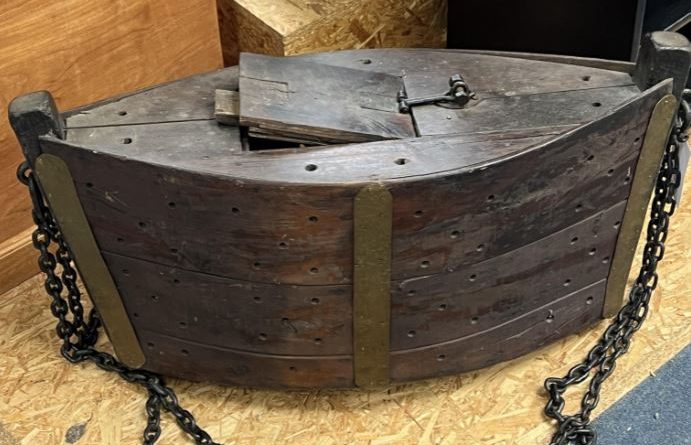
Can you solve the mystery of this unusual antique device?
Shaped to hug the pull of the current, this antique fish holding apparatus once transformed wild rivers into living pantries. Long before refrigeration reshaped food storage and trade, fishermen relied on moving water itself to preserve their catch. Rivers were not just sources of fish but active partners in survival. After hauling fish from nets or lines, the fisherman slid the wriggling bodies through a simple latched lid and into the wooden box. The cage was then chained securely to rocks, thick tree roots, or the riverbank, anchored carefully against the relentless force of the flow. What followed was a quiet act of trust, not in machinery or innovation, but in nature’s steady and predictable reliability.
The design was deceptively simple, yet deeply intelligent. Perforated wooden slats allowed cold river water to stream continuously through the container. Fresh oxygen circulated without effort, waste was carried away by the current, and the fish remained alive rather than slowly spoiling in the heat. In effect, the river itself became a life support system. There were no moving parts to fail, no fuel to gather, and no maintenance beyond careful placement and sturdy construction. The fisherman understood something fundamental, that as long as the water moved, life could be sustained.
For river communities, this was not an interesting object or a clever convenience. It was security in its most literal form. A full fish cage meant food for the family that night and the next. It meant something to trade at the market, protein through lean seasons, and a buffer against hunger when luck ran thin. In places where every meal depended on skill, timing, weather, and patience, the ability to keep fish alive extended opportunity. A good catch did not have to be rushed, smoked immediately, or lost to heat. It could wait until it was needed.
These cages were often built from dense hardwood reinforced with iron fittings, materials chosen not for beauty but for endurance. They had to survive rushing floods, shifting debris, freezing winters, and years of constant submersion. Many were passed down through families, repaired rather than replaced, reused season after season. Their surfaces grew smooth from water and handling, darkened by age and minerals. Each scratch, warped board, and rusted hinge told a story of labor, patience, and adaptation passed quietly from one generation to the next.
There was also knowledge embedded in their use. Fishermen learned to read the river, to know where currents were strong enough to refresh the cage without tearing it loose. They understood temperature changes, seasonal flows, and how different species responded to confinement. Placement mattered as much as construction. A poorly chosen spot could mean dead fish or a lost cage. Success depended on observation, restraint, and respect for forces that could not be controlled.
Today, when such a cage sits dry and silent, perhaps hanging in a barn or displayed behind glass in a museum, it feels strangely humble. It does not announce its importance. Yet it carries a powerful reminder. Survival once depended not on humming compressors, sealed plastics, or digital temperature controls, but on close attention and cooperation with the natural world. People studied currents, temperatures, and river behavior, then shaped tools to work with those forces rather than fight them.
The antique fish cage stands as evidence of an intimate relationship between human need and moving water. It reflects a time when preservation was not about domination, but balance. By letting the river do the work, fishermen extended life, reduced waste, and fed entire communities. In its quiet simplicity lies a lesson that still resonates today. Sometimes the most effective solutions are not the loudest or most complex, but the ones that listen carefully to nature and move with it, allowing what already exists to sustain what we need most.