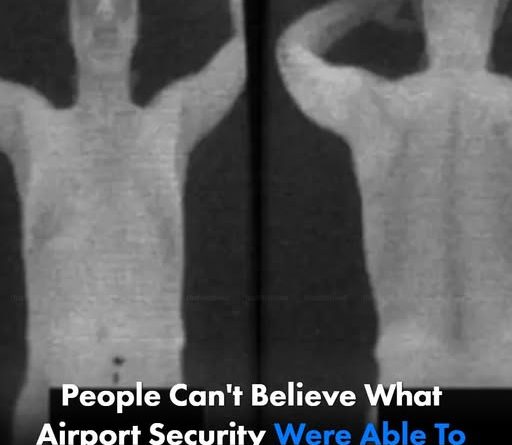
Old Airport X-Ray Secrets
The old airport body scanners were once widely criticized as “virtual strip searches,” a phrase that captured public unease more than technical nuance, yet not without justification. For many travelers, the experience of airport security has long carried a sense of vulnerability. Shoes off, pockets emptied, personal belongings examined. When full body scanners entered the scene, that discomfort took on a new and more personal dimension.
Anyone who passed through airport security in the early 2010s likely remembers the awkward pause before stepping into the scanner, feet placed just so, arms raised above the head, instructions delivered through thick glass. At the time, many passengers did not fully understand what those machines were capable of seeing. Only later did it become clear that some of the imaging technology revealed far more than most people believed acceptable in a public setting.
After the failed Christmas Day bombing attempt in 2009, Transportation Security Administration moved quickly to close perceived security gaps. One response was the rapid deployment of advanced imaging technology, including backscatter X ray scanners manufactured by Rapiscan. These machines were designed to detect nonmetallic threats hidden under clothing, something traditional metal detectors often missed. From a security standpoint, the logic was clear. From a privacy standpoint, the implications were unsettling.
Early backscatter scanners produced highly detailed outlines of passengers’ bodies. While officials stated that the images were viewed in separate rooms, that faces were blurred, and that no images were stored, trust quickly eroded. Once examples of the scans circulated publicly, many travelers felt misled. The images revealed intimate anatomical detail, leaving little to the imagination. Privacy advocates argued that intent mattered less than effect. Being exposed in such a way, even briefly and even anonymously, felt like a violation to many.
Critics began calling the process a virtual strip search, questioning how much personal privacy society should surrender in the name of safety. Online discussions filled with anger, disbelief, and concern. Some travelers doubted whether the scanners meaningfully improved security at all, while others worried about mission creep, the gradual acceptance of increasingly intrusive measures simply because they became routine.
Pressure mounted, and by 2013 the tide turned. New federal requirements mandated the use of Automated Target Recognition software, which replaced realistic body images with generic outlines. Backscatter scanners that could not be upgraded to meet these standards were removed from airports entirely. In their place came millimeter wave scanners, which use abstract imaging to highlight potential threats without exposing identifiable physical features.
These newer systems marked a shift in philosophy. Instead of displaying the body, they focused on anomalies. Threat detection was separated from personal exposure, addressing many of the earlier privacy concerns. Media scholar Shawna Malvini Redden later observed that early scanner deployments prioritized speed and capability over ethical safeguards, while modern systems reflect lessons learned from public backlash.
The episode stands as a reminder that technological capability often advances faster than ethical consensus. Tools can be built and deployed long before society fully agrees on how they should be used. Once privacy boundaries are crossed, restoring trust is far more difficult than maintaining it in the first place.
Airport security remains essential, and few argue against the need for protection. Yet the scanner controversy illustrates why restraint matters. Vigilance is required not only against external threats, but also against the quiet normalization of intrusion. Safety and dignity are not mutually exclusive, but balancing them demands transparency, accountability, and a willingness to listen when the public says a line has been crossed.